News – full story
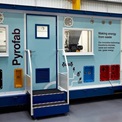
The Pyrofab can use a wide range of waste and biomass feedstocks
27/07/2015
Aston turning hard-to-treat waste into energy
Pyrofab module fits into shipping container
Helen Tunnicliffe
ASTON UNIVERSITY in Birmingham, UK, is testing its new Pyrofab module, designed to produce energy from hard-to-treat waste such as domestic waste, agricultural waste, industrial waste and even baby wipes.
The Pyrofab module has been designed and built at Aston’s European Bioenergy Research Institute (EBRI). It is small enough to fit inside two standard shipping containers, meaning that it is easily transportable. It is designed to convert carbon from a wide range of locally-available sources of waste and biomass that would otherwise be sent to landfill.
Once it is fully developed, the researchers at Aston’s European Bioenergy Research Institute (EBRI) say that the Pyrofab will allow businesses and local authorities to tap into bioenergy markets. Demand for bioenergy is expected to grow by 49% from 2012–2040. The technology can work alongside existing energy generation technology, and as it is adaptable to local sources of carbon, it will reduce the environmental impact of fuel transportation and reduce the reliance on imports. The Pyrofab could stimulate rural economies and job creation, and lower waste treatment costs.
The Pyrofab module has been developed as part of an EU-funded bioenergy project, BioenNW. It has two parts. The first is the conversion technology, which uses EBRI’s Pyroformer technology. This uses intermediate pyrolysis to turn the feedstock into carbon-netural oil and gas fuels and biochar, which has a commercial value as a soil improver. The system has a twin screw to force the material through the sealed environment at temperatures of around 500˚C. The second part is a monitoring lab and results analysis facility.
Two Pyrofab prototypes are ready to go on a tour of four BioenNW partner sites to test the potential of different local biomass and waste materials. It will visit the Rittmo research centre in Ile-de-France in France, the Institut für ZukunftsEnergieSysteme (IZES) in Saarland in Germany, agricultural and technical college Helicon in Boxtel in the Netherlands, and the European Biomass Industry Association (EUBIA) in Sollefteå, Sweden. The results from the tour and EBRI’s own tests will be collated and used to form BioenNW’s business support tool for the project, which is designed to help companies plan how to deliver local bioenergy.
Tony Bridgwater, director of EBRI, says that while baby wipes and food leftovers might not immediately spring to mind when thinking about energy security, using such wastes could play a role in delivering Europe’s environmental targets and improve energy security.
“The Pyrofab unlocks the potential of waste, producing sustainable carbon-neutral bioenergy and biofuels. This has the potential to change a significant liability for businesses and local authorities across North West Europe into a home-grown resource, to reduce waste management costs and generate new revenue streams through the derived products,” he adds.
